


Beautiful people,
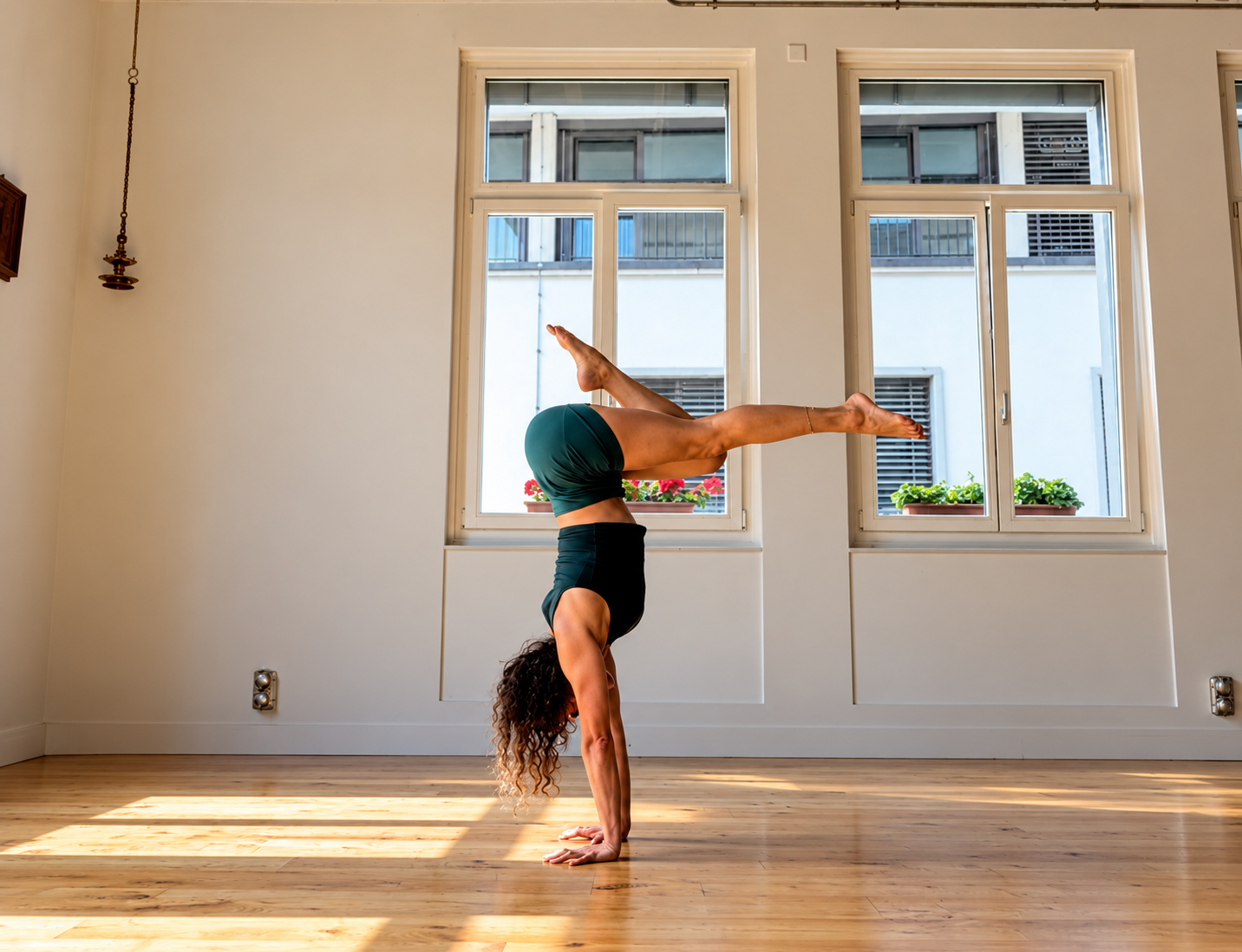
I feel there is some confusion about how to integrate handstand work into your practice. I have been observing quite a bit of random sequencing during Mysore practice, and I would like to clarify something important, particularly for those of you who would like to better understand how to structure your practice on the days you practise at home, as well as those of you who are already teaching or intend to teach.
By random sequencing, I mean adding postures, drills, or exercises wherever you feel like doing them, without considering their purpose, how they relate to what comes before and after, or how they affect the progression and overall balance of the practice.
For example, introducing handstand drills, push-ups, or upper-body conditioning in the middle of a sequence simply because you want to improve a particular skill, without considering the continuity of breath, the generation and direction of heat, the movement of prāṇa, or the quality of mind the sequence is intended to cultivate.
An exercise can be beneficial in isolation without being appropriate at every point in a yoga sequence.
A clarification about individual technical work
Please do not take the work I am doing with Romain during this particular phase as a reference for how to structure your own practice.
Romain has practised with me for seven years, progressing through the traditional sequences up to halfway through Advanced B (Fourth Series), following the prescribed vinyāsa and without skipping postures. He has spent years doing the foundational work.
At this stage, I am refining specific aspects of his handstand technique. This is individual technical work, not an example of how I would design a coherent yoga āsana sequence.
Understanding the purpose of sequencing
A yoga sequence is not a collage of postures assembled according to what we feel like practising that day.
The progression through standing, seated postures, twists, backbends, inversions, and finishing postures has an underlying logic.
We are working with breath, heat, the vāyus, attention, and the circulation and direction of prāṇa through the body. But we are also considering the particular qualities of each posture and each family of postures, and how their arrangement influences the practitioner as a whole.
Different postures, and the way they are sequenced, can cultivate different qualities of energy, attention, and mind.
Some postures are more stimulating, heating, and activating. Others encourage grounding, stability, introspection, or a settling of the nervous system. Standing postures, forward bends, twists, backbends, inversions, and finishing postures each have their own characteristics, and their effects depend not only on the posture itself but also on how it is practised, what precedes it, and what follows.
From the perspective of the guṇas, we can examine how the practice influences the balance between rajas, tamas, and sattva. Are we continually increasing stimulation and activity? Are we becoming heavy, dull, or depleted? Or are we gradually cultivating greater clarity, balance, and steadiness?
A posture does not have one fixed guṇa. Its influence depends on the practitioner, the quality of effort, the breath, and its place within the sequence.
This is why the progression matters. We may deliberately generate heat and activity in one phase, direct that energy through particular movements and postures, and then gradually move towards containment, integration, and stillness.
We must consider how the different families of postures influence the vāyus, how they affect the movement and distribution of prāṇa, and how the transition from one posture to another changes the quality of the practice.
How do we generate heat, and what do we do with it? How do we collect and direct prāṇa? When do we encourage expansion and stimulation, and when do we cultivate grounding and containment? How does the sequence influence our mental activity, emotional state, and capacity for sustained attention?
The purpose is not simply to accumulate physical effort or energetic stimulation, but to understand how the different qualities of practice work together to create a coherent whole.
A well-designed sequence considers not only what each posture does individually, but what happens through their relationship to one another, and how that progression supports the cultivation of a more balanced and sattvic state of mind.
For example, inserting handstand work all of the sudden after the standing sequence, into a part of the sequence intended to ground and settle the practitioner can introduce an unnecessarily rājasic quality. You repeatedly stimulate the system when the progression is intended to develop rooting, stability, and a more settled quality of attention.
Similarly, generating considerable heat through the salutations and standing sequence and then suddenly lying face down on the floor to perform a drill I use with four blocks to enhance proprioception for inversion work interrupts the progression I am trying to teach.
That drill has a purpose, but it belongs within a particular context.
What are we actually cultivating?
This is not only about handstands.
I also observe some of you becoming increasingly focused on particular physical accomplishments: developing more upper-body strength, improving jump-backs and jump-throughs, achieving greater flexibility to put the leg behind the head or achieve lotus, or repeatedly working on a particular movement until you can perform it.
There is nothing wrong with developing these skills. I enjoy them myself, and I have spent many years studying and refining movement.
But when one physical quality becomes the dominant focus of your practice, we need to ask what is happening to the whole.
Are you developing strength at the expense of mobility? Flexibility without stability? Are you repeatedly exhausting the same muscles and tissues while neglecting other aspects of your body?
Are you continually generating more effort and stimulation without allowing the practice to move towards integration and stillness?
A coherent āsana sequence considers the relationship between different regions of the body, different qualities of movement, and the progression of effort.
But it also considers something beyond the musculoskeletal system.
What are we cultivating through all this effort?
The Neijing perspective: cultivating Shén and nourishing life
This is where I would like to share something from my studies of nature-based Neijing medicine and Daoism that are the the basic foundations of oriental medicine and their interesting correspondences with yoga and Ayurveda.
Although these traditions have different philosophical foundations and methods, they share an important concern: the cultivation of life involves much more than developing the physical body.
In the Huangdi Neijing, the art of nourishing life, yǎngshēng, is concerned with preserving vitality, maintaining the harmonious movement of Qì, and cultivating Shén.
Shén is often translated as spirit or mind, but neither word fully captures its meaning.
It concerns our presence, consciousness, awareness, emotional life, and our capacity to experience clarity, connection, and inner peace.
In Chinese medicine, the Heart is said to house the Shén.
When Shén is settled, we are better able to think clearly, sleep deeply, respond rather than react, and remain rooted even when life around us becomes uncertain.
When Shén is disturbed, we may experience the opposite: restless thoughts, emotional agitation, disturbed sleep, difficulty recovering, and a persistent sense of being unsettled.
From this perspective, the cultivation of the mind and emotional life is inseparable from the cultivation of the body.
You can train your muscles every day. You can become exceptionally strong, flexible, and physically accomplished.
But if your inner landscape remains constantly restless, hurried, fearful, or overwhelmed, physical accomplishment alone will not resolve that condition.
You cannot simply outrun your inner landscape through physical effort.
And this brings us back to an important question:
What state of mind are we cultivating while we practise?
Are we developing the ability to direct our attention and remain steady, or are we continually stimulating ourselves and feeding the same restlessness that accompanies us throughout the day?
In Daoist cultivation, movement and stillness are complementary. We find this relationship in practices such as Qigong and Tai Chi, where physical movement, breath, awareness, and periods of quiet standing or meditation can support one another.
The purpose is not simply to make the body stronger or more capable, but also to cultivate the capacity to remain centred.
And why is this important?
Because the steadiness we cultivate during practice should eventually become available to us in the rest of our lives.
Can you remain rooted when someone challenges you?
Can you breathe and create space before reacting?
Can you experience anger, sadness, disappointment, or fear without being completely consumed by those emotions?
Are you constantly dispersing your energy in different directions, taking on more and more activities without bringing them to completion? Or are you able to gather your attention, direct your energy towards what truly matters, and sustain your efforts long enough to bring your intentions and visions into reality?
Can you distinguish between what genuinely deserves your energy and what continually drains it without leading anywhere?
Being centred is not simply about remaining calm. It is also about having the clarity to choose where your energy goes, the steadiness to remain committed, and the discernment to recognise what deserves your attention and effort.
Can you meet uncertainty and change without loosing your center?
In Chinese medicine, emotions are understood in relation to the movement of Qì. Emotional cultivation does not mean suppressing our feelings or attempting to remain peaceful at all times.
It means developing the capacity to experience emotions without continually losing our centre.
Stillness is not the opposite of strength. It is another expression of strength.
There is strength in being able to generate considerable effort, but there is also strength in knowing when to stop, when to conserve, and how to remain steady in the midst of difficulty.
The cultivation of Shén, the preservation of Jīng ( our foundational life essence and vitality), and the harmonious movement of Qì are interconnected concerns within the Neijing understanding of nourishing life.
The relationship to yoga: what is the mind doing while the body practises?
In yoga, we find interesting parallels through the regulation of prāṇa, the cultivation of sattva, and the relationship between physical practice and the stilling the fluctuations of the mind.
Patañjali describes yoga as yogaś citta-vṛtti-nirodhaḥ (Yoga Sūtra 1.2), commonly understood as the stilling of the fluctuations of the mind.
And when describing āsana, he gives us sthira-sukham-āsanam (Yoga Sūtra 2.46): posture should embody steadiness and ease.
The Bhagavad Gītā offers another perspective through the three guṇas.
Rajas is associated with activity, passion, restlessness, and attachment to action and its results. Sattva is associated with clarity, harmony, and illumination.
We need activity. We need effort. We need the capacity to act.
But if our practice continually reinforces restless striving, attachment to achievement, and the need for more stimulation, what are we actually cultivating?
The mind that constantly chases the next physical accomplishment does not necessarily become quieter simply because those accomplishments take place on a yoga mat.
This is why I encourage you to observe your relationship with the practice itself.
What happens when you cannot perform a particular posture?
Can you practise something simple with the same quality of attention you bring to an advanced āsana?
Can you recognise when your desire to accomplish something has become stronger than your ability to listen?
Can you work intensely without becoming consumed by intensity?
These are also opportunities for yoga.
In the Neijing tradition, we ask whether our activities and habits are nourishing our vitality or continually exhausting it.
In yoga, we consider how our practice influences prāṇa, the vāyus, our attention, and the quality of our mind.
A balanced practice should not simply make you capable of doing more. It should also develop your capacity to act without continually scattering your energy.
You may finish your practice having worked intensely, generated considerable heat, and challenged your physical capacities, yet still feel nourished, steady, clear, and inwardly settled.
There is a difference between the peace that comes from balance and the apparent stillness that comes from complete exhaustion.
Śavāsana is not meant to be the moment when you collapse because you have depleted yourself through effort.
And this is not only about how you feel during the final minutes of practice.
You may practise for an hour or two, but you must live with your mind throughout the rest of the day.
What is the value of developing extraordinary physical capacities if we remain unable to find steadiness in our relationships, our emotions, and the challenges of everyday life?
This is not to suggest that yoga practitioners should never experience anger, anxiety, sadness, or emotional difficulty.
It is to recognise that practice can gradually develop our capacity to meet these experiences with greater awareness and discernment.
Why a yoga class is different from a workout or conditioning class
A yoga āsana class is different from a workout, a conditioning class, a technical workshop, or a class dedicated to developing a particular physical skill.
Each has its purpose, and I value all of them. I practise strength training myself, and I have spent much of my life studying movement, dance, martial arts, and the development of physical capacities.
There is nothing wrong with wanting to sculpt your body, become stronger, more flexible, or more technically accomplished.
But these are not the only objectives of yoga āsana, nor are they what fundamentally distinguishes yoga from other forms of physical exercise.
The distinction is not simply in which postures we perform, but in how we practise them, how they are organised, what we direct our attention towards, and what the practice is intended to cultivate.
This is why I find the increasing branding of classes as Yoga Sculpt, Yogalates, and other fitness-oriented variations concerning.
Not because these forms of exercise have no value, but because when yoga becomes primarily a method for sculpting the body, burning calories, developing muscle tone, or accomplishing impressive postures, something essential about the tradition is gradually lost.
The concern is not that people are combining yoga-inspired movements with fitness. It is that these combinations are increasingly presented as yoga itself, without transmitting the understanding of what yoga is intended to cultivate.
When this becomes the dominant representation of yoga, students begin to associate it primarily with physical performance, flexibility, strength, and appearance, while its relationship to breath, prāṇa, attention, consciousness, and the cultivation of the mind becomes secondary or disappears altogether.
This is particularly concerning when people begin teaching without sufficient study or experience to distinguish between these different approaches.
A conditioning class can make you stronger. A technical workshop can improve your handstand. A mobility class can increase your range of movement.
All of these are valuable, but they do not necessarily constitute a yoga practice.
Why I ask you not to insert handstands randomly into your practice
When I suggest that you do not suddenly insert handstand drills in the middle of your sequence, there is a great deal of knowledge and reasoning behind that guidance.
It is not about being controlling, strict, or rigid-minded.
It comes from years of practice, study, observation, and an understanding of what we are trying to cultivate through yoga.
I love handstands. Handstands are fun! I enjoy practising them, refining them, and teaching them.
Over the years, I have offered several handstand workshops here at Casa Vinyasa, and I have shared basic techniques and drills that you can continue working on independently.
Handstand training has its place. It is simply not the objective of yoga.
When you come into the Mysore room, I am offering you something beyond physical techniques and accomplishments.
I am trying to share yoga with you.
Part of learning yoga is developing the discernment to understand not only how to perform a posture, but why we practise it, when we practise it, and how it relates to the practice as a whole.
Please do not mistake the freedom of developing a personal practice for the freedom to assemble postures without understanding their purpose.
The Mysore room offers you the opportunity to develop independence, but that independence grows through understanding the method.
A practical reminder
If you would like to integrate handstand work into your practice, please ask me where and how to do so.
I have already given some of you specific guidance about where to incorporate certain techniques, but I notice that these instructions are sometimes forgotten, not followed, or not integrated into your practice. This is also why I encourage you to bring your notebook and write down the guidance you receive.
I have also shared techniques and drills that you can practise independently, at another time of day or on other days, when you wish to dedicate 20–30 minutes specifically to developing your handstand skills.
Please distinguish between technical training that you can do independently and the work we are cultivating through a yoga āsana sequence. They serve different purposes, and understanding that distinction is part of your learning.
I would love for you to enjoy handstands, explore them, and develop your skills.
But above all, I would love for you to recognise that what I am trying to transmit to you through yoga is much more than the ability to perform an āsana.
The purpose is not simply to become stronger, more flexible, or more accomplished, but to cultivate a practice that nourishes the body, regulates our energy, and brings greater steadiness and clarity to the mind.
And ultimately, to carry those qualities beyond the yoga mat, into the way we meet ourselves, others, and the circumstances of our lives.