Mysore Room Etiquette
Guidance for Practice at Casa Vinyasa
- Respect the Teacher and the Space
All over the world, in any Mysore room, when you are present with a teacher who has actually lived
the Mysore room and the tradition of Ashtanga Yoga, the same etiquette applies.
No matter who you are — a proficient practitioner, a famous teacher, a top yogi — when you are
present in a Mysore room you concentrate on your own practice and you respect the norms and
etiquette of the teacher holding that space.
This is a practice of humility.
If the teacher says no props, shorter triangle, this yes, this no — you do not argue. When you travel
and practice elsewhere, you respect the teacher holding space.
You do not need to endure harsh or harmful adjustments. If you do not want to be adjusted, you can
simply say that you prefer not to be touched or adjusted and that you prefer verbal corrections.
If you do not like how things are done in that school, you simply stop going. You do not return.
Simple. You do not argue, and the teacher has no need to convince you of their way.
- Never Adjust or Assist Another Student
When attending a Mysore practice anywhere in the world, you will never get up in the middle of
the class and go help another student or adjust them.
This is absolutely not acceptable. It is a complete no-go in a Mysore room, and usually the
teacher would stop that immediately.
There are many reasons for this. Only an assistant working under the supervision of the teacher may
help, and only in the way the teacher has asked.
This is not hierarchy. This is professionalism and respecting the container and the person holding
that container that day in that classroom.
- The Only Exception: Supta Vajrasana
Assistance
The only moment you may help another student is in the posture Supta Vajrasana in Second
Series, and only if:•
you yourself practice this posture
the teacher has shown you how to assist
the teacher has asked you to help
This is done with minimal conversation and in silence.
Stop talking so much together.
Get the job done and leave.
Talking during this moment is distraction.
All that needs to be said are simple functional words like:
“Give me space for my knee.”
or
“Help me with my hand.”
Finished.
- Waiting Is Part of the Practice
Even if the person next to you is a complete beginner and has to wait to receive help or the next
instruction, they are learning to wait and be patient.
Waiting and breathing is part of the practice.
Not receiving an adjustment and having to figure something out is also part of the teacher’s strategy
and way of teaching.
The teacher does not help everybody in binding, Supta Kurmasana, or backbends every time.
Sometimes the student is left alone and autonomous, just as they would practice at home.
There is a lot a teacher holds in mind as part of their strategy and lesson plan for each student.
Sometimes a teacher may purposely ignore a needy student, or someone constantly seeking
validation.
Sometimes someone needs to become autonomous and trust themselves.
You have no idea what is happening in the teacher’s mind and why they do what they do. We do not
have to explain everything.
- Silence and Focus During Practice
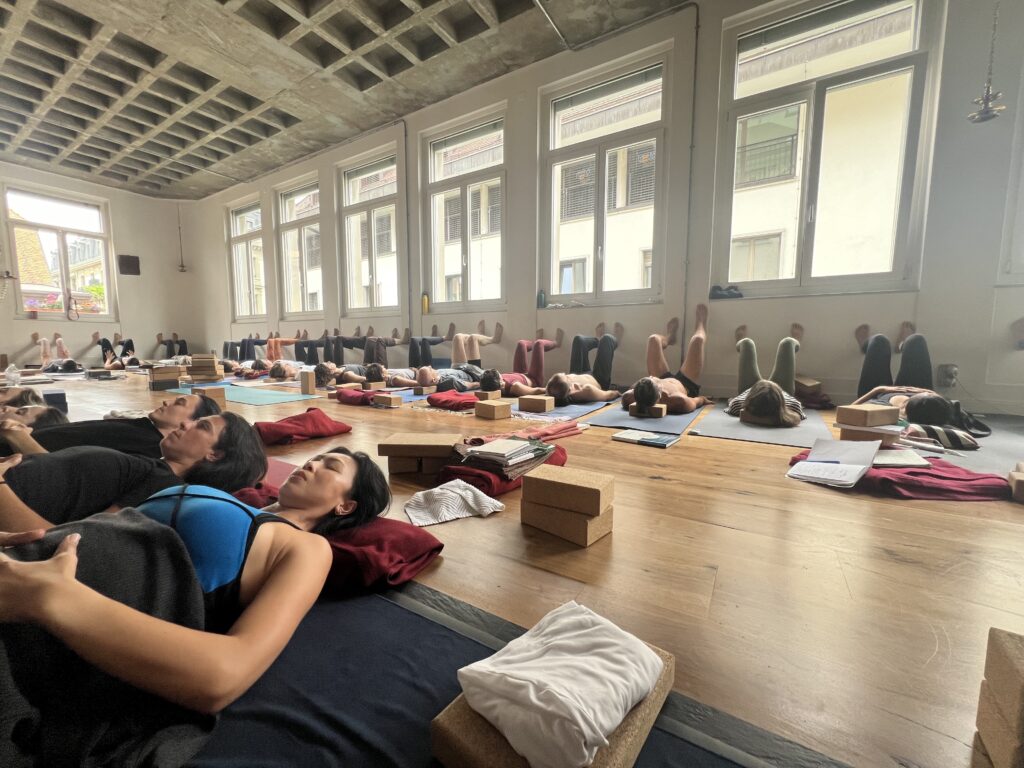
Please avoid unnecessary conversation during practice.
Do not start philosophical discussions in the middle of your practice. When there are extra words,
arguing, or discussions, I simply walk away.
All of this is distraction.Experienced long-time practitioners do not do this. They practice with the focus of a samurai.
When you go to get elastic bands or props, do not lose focus. You are in another state.
This is not like a gym where people walk around, drink water, and chat.
You are focused — one thing, then the next.
- Mind Your Own Practice
Some of you get easily distracted — who is pregnant, who is doing what, who looks good today,
commenting on someone’s posture, asking where props are, asking questions to each other.
The moment you enter the practice space you enter a different mental space and zone.
You are unaware of what your classmates are doing.
You mind your own business.
Unless I call your attention to look at something I am teaching, ask you to come observe something,
or address the room collectively.
This is what I invite you to step into.
- What Advanced Practice Really Means
Being distracted from your practice is not proficiency.
It is not advanced practice.
It is dispersion.
Advanced practice is not the complexity of postures.
It is the quality of presence.
The more experienced you are and the more years you have been practicing, the more this should
show — from the moment you walk into the studio until the moment you leave.
- Teacher–Student Relationship
If you want to learn well and have a shala that is a supportive space and community nourishing your
practice, do not seek friendship with the teacher.
I care deeply about all of you. I am grateful for your presence in my life every day. You are precious
members of this community and I enjoy sharing what I love with you.
I will show up as the best version of myself to support you on this path and to be there for you. I
have a tender place for all of you in my heart.But being community members is not the same as friendship.
Friendship can damage the student–teacher relationship and the dynamic of efficient learning.
I keep this boundary because I care about you and about your practice.
Friendship has happened with a few people in a natural way, where there is maturity to navigate
both the student–teacher moments and the friendship moments. I only have that with two or three
people in the shala.
This is not because they are special. It is something I purposely avoid, even when someone could be
very interesting as a friend.
This is my profession, and your learning and growth on this path is my dharma and responsibility.
Please also do not call me a friend when we do not actually have a friendship outside the shala.
- Protecting the Energy of the Space
Gossiping, talking about other people’s lives, being nosy, wanting to know about my private life or
other people’s lives — these are low-energy behaviors.
They are draining and cheap.
My energy filters them away by nature. Sometimes I come down like an axe.
My personality protects this space and removes what does not belong here.
Because I am the protector of this space.